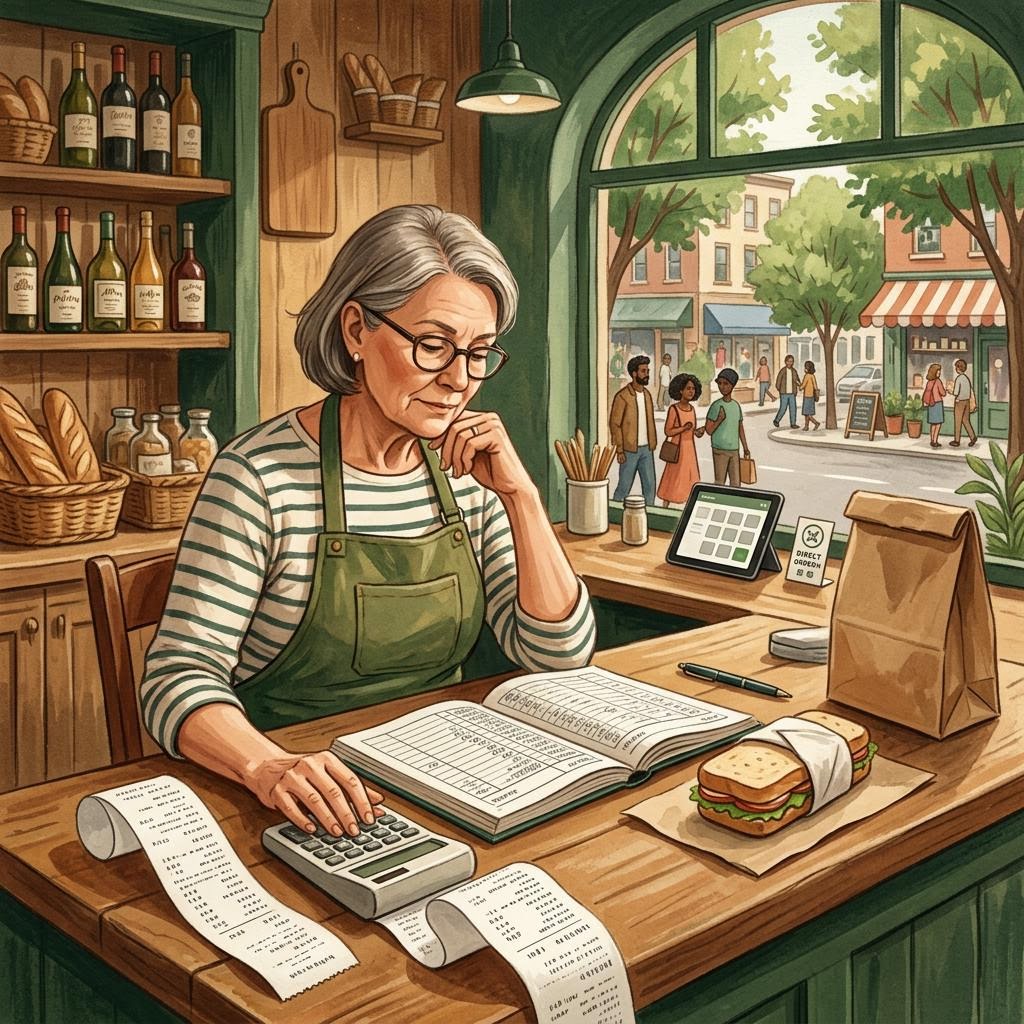
What Is DoorDash Really Costing Your Restaurant in 2026? A Breakdown of Fees, Commissions and the Math Behind Every Order
Javan Calhoun — Founder of TRELVN
Delivery Apps and Fees
DoorDash can put your restaurant in front of customers who might never have found you otherwise.
That has value.
But every restaurant owner should be able to answer a simple question:
What is DoorDash actually costing my restaurant?
Not what another restaurant owner says they're paying. And not simply the percentage printed on a pricing page.
What matters is what the platform costs your restaurant, what you receive in return, and whether those economics make sense for your business.
Let's look at the numbers.
First: How DoorDash charges restaurants
DoorDash currently advertises three primary Marketplace plans for qualifying U.S. restaurants:
Basic — 15% delivery commission
Plus — 25% delivery commission
Premier — 30% delivery commission
DoorDash currently lists pickup at 6% across all three plans, subject to its applicable terms.
The higher tiers aren't simply charging more for the same thing. DoorDash says they can provide benefits such as greater customer reach, lower customer delivery fees on qualifying orders, access to DashPass customers and additional marketing features.
That's important.
A restaurant owner shouldn't evaluate a marketplace commission as though they're receiving nothing in return.
You're paying for access to an existing marketplace, customer discovery, technology, support and, for delivery orders, logistics.
The question is whether the economics make sense for your restaurant.
What does a 25% commission actually look like?
Percentages can feel abstract.
Dollars don't.
Suppose your restaurant generates $8,000 per month through a marketplace charging a hypothetical 25% commission.
That would mean:
$8,000 × 25% = $2,000 per month
Over a year:
$2,000 × 12 = $24,000
That's $24,000 per year in marketplace commission.
At $15,000 in monthly marketplace sales at the same hypothetical rate, the commission would be $3,750 per month—or $45,000 per year.
Those numbers aren't presented to suggest that the marketplace provided nothing in return.
It generated the orders.
So the more useful question is:
What did those orders produce beyond today's transaction?
A commission isn't automatically a bad deal
Suppose DoorDash introduces your restaurant to someone who has never heard of you.
They open the app looking for Caribbean food.
Your restaurant appears.
They order $40 worth of food.
They love it.
Without the marketplace, perhaps that order never happens.
Paying to acquire that customer may make perfect business sense.
Restaurants already spend money trying to attract customers through advertising, discounts, promotions, social media and other channels.
A marketplace can perform a similar acquisition role while also facilitating the transaction.
That's why simply saying "25% is too expensive" doesn't tell you enough.
The more important question is what happens after the customer discovers you.
What happens when that customer comes back?
Suppose that $40 customer orders again.
Then again.
Over time, they place 10 orders averaging $40 each.
That's $400 in customer revenue.
It is not $400 in profit. To assess the customer’s long-term value to the business, you also need to consider the costs of acquiring and serving them.
Food, labor, packaging, fulfillment, payment processing, discounts, marketplace or software costs and other expenses all affect how much of that revenue the restaurant ultimately retains.
But the example reveals something important:
There is a difference between paying to acquire a customer for the first time and repeatedly paying an intermediary when an existing customer comes back.
If the marketplace keeps generating value for those repeat transactions, the cost may still be justified.
But owners should know what they're paying for.
Direct ordering isn't free either
This is another important part of the calculation.
Direct ordering does not mean zero cost.
Your restaurant may still pay for:
- Payment processing
- Ordering software
- Delivery fulfillment
- Website services
- Marketing
- SMS or email
- Loyalty programs
- Integrations
- Other technology
So comparing a marketplace commission against "$0" isn't an honest comparison.
The useful comparison is:
What does it cost me to generate and fulfill an order through each channel—and what does each channel provide in return?
Marketplace ordering can provide discovery, demand and logistics.
Direct ordering can provide different economics and greater control over the restaurant's direct customer relationship.
Both can have a role.
DoorDash itself makes this distinction
DoorDash doesn't only sell Marketplace access.
It also offers a DoorDash Online Ordering product for orders placed through a restaurant's own channels.
DoorDash currently describes its Online Ordering product as commission-free, although payment-processing fees and other applicable costs can still apply.
That's an important distinction.
Marketplace discovery and direct ordering don't necessarily have to compete with each other.
They can perform different jobs.
NYC restaurants have different rules
For New York City restaurants, national Marketplace pricing doesn't tell the entire story.
NYC law establishes separate fee categories for third-party delivery services.
Under current city rules, delivery fees are capped at 15% of the purchase price of an online order, subject to limited exceptions.
Electronic transaction fees are capped at 3%, again with limited exceptions.
Platforms must also offer restaurants a basic service option capped at 5%, subject to limited exceptions. That basic service includes core platform access, including being listed and discoverable.
A platform may additionally offer optional enhanced services, for which the enhanced-service fee is capped at 20%, subject to limited exceptions.
But there's an important condition:
A platform can charge an enhanced-service fee only if it also offers restaurants the basic-service option at or below the 5% cap.
In other words, don't simply add:
15% + 3% + 5% + 20%
and assume every NYC restaurant automatically pays all four.
The applicable cost depends on the services the restaurant selects, whether delivery and payment processing are involved, applicable exceptions, and the restaurant's agreement with the platform.
Restaurant owners should review their actual contracts and itemized statements rather than applying a national headline percentage to their NYC business.
New York's regulatory environment is also evolving.
On September 22, 2026, the city announced a $131.5 million DoorDash settlement concerning delivery-worker pay practices.
It was not a finding that DoorDash overcharged restaurants, but it demonstrates how quickly the environment surrounding restaurant-delivery platforms can change.
Read our full breakdown: DoorDash’s $131.5 Million NYC Settlement: What Independent Restaurant Owners Should Know.
Pull your last 90 days
You don't need a complicated financial model to begin evaluating your channels.
Pull approximately three months of restaurant sales and separate your orders by channel.
For each channel, identify:
Total sales — How much revenue came through it?
Total fees and costs — What did you actually pay to generate and fulfill those orders?
Number of orders — How many transactions produced that revenue?
Average order value — How much did the typical order generate?
New versus repeat customers, where reporting allows — Does the available data tell you whether customers are returning?
Don't assume every marketplace will provide enough information to reliably identify every new and repeat customer.
And customer information obtained through a marketplace shouldn't automatically be treated as a restaurant-owned direct-marketing list. Restaurants should follow the platform agreement, applicable customer-consent requirements and privacy laws governing how customer information can be used.
Even without perfect customer-level data, you can calculate something useful:
Total channel cost ÷ channel sales = effective channel cost percentage
For example:
If a channel generates $10,000 in sales and your restaurant incurs $2,000 in applicable channel costs:
$2,000 ÷ $10,000 = 20%
Now you have a number you can compare against other channels.
Compare your direct channel honestly
Run the same exercise for orders placed directly with your restaurant.
Include the real costs:
payment processing,
software,
delivery,
marketing,
promotions,
and anything else required to generate and fulfill those orders.
But there's one important rule:
Use the same sales basis and comparable cost categories across every channel.
If you're calculating marketplace costs against order sales before taxes and tips, for example, use that same basis when evaluating direct orders.
And if you include delivery, payment processing or promotional costs for one channel, include comparable costs for the others.
Otherwise, you may end up comparing percentages that look similar but actually measure different things.
Then compare.
You may discover marketplaces are extremely valuable for acquiring customers.
You may find direct ordering produces better economics for some repeat business.
Or you may discover that a combination of both works best.
That's the point.
Don't ask, "Should I leave DoorDash?"
For many independent restaurants, that's probably the wrong question.
Ask instead:
What is DoorDash doing for my restaurant?
How much am I paying for that value?
How many incremental orders is it producing?
Where reporting allows, are those customers returning?
What percentage of my digital business depends on one platform?
Am I also building a direct channel that I control?
Those questions lead to strategy.
Your numbers—not a blanket opinion about delivery apps—should determine how each channel fits into your business.
The strongest strategy may be both
Marketplaces have something independent restaurants often struggle to build themselves:
Massive consumer attention.
Your restaurant has something a marketplace can't replace:
Your food, your brand and the relationship people develop with your business.
Use marketplaces when they create enough value to justify their cost.
Give those customers an experience worth returning for.
And make your direct ordering option easy to find for customers who choose to build a direct relationship with your restaurant.
The objective isn't necessarily to eliminate marketplace sales.
It's to build a healthier mix of channels so your restaurant isn't completely dependent on any single company.
Know what you're paying. Know what you're building.
The mistake isn't necessarily paying a marketplace commission.
The mistake is paying without understanding whether the channel is working for your restaurant.
If DoorDash produces profitable incremental orders and introduces your restaurant to customers you otherwise wouldn't have reached, that's valuable.
If your restaurant also develops a strong direct channel for customers who already know your business, that can be valuable too.
The goal isn't marketplace versus direct.
It's understanding what each channel is supposed to accomplish.
Let marketplaces help people discover you.
Give customers a reason to return.
And build a direct relationship with the customers who choose to order from you directly.
That's a healthier foundation for an independent restaurant.
About TRELVN
TRELVN helps independent restaurants build their own direct digital ordering and customer relationships.
With $0 commission on direct orders, TRELVN provides tools for online ordering, loyalty, marketing, customer relationships and restaurant operations while allowing owners to continue using third-party marketplaces where those platforms create value.
The goal isn't to replace every channel your restaurant uses.
It's to help you build one that belongs to you.
What could the numbers look like for your restaurant?
Use the TRELVN ROI Calculator to compare marketplace costs with the economics of building a direct ordering channel.
Sources checked September 27, 2026. Pricing and regulations can change. This article is informational and is not legal or financial advice.
Sources
- DoorDash for Merchants — DoorDash Commission Rates & Pricing — DoorDash for Merchants
- DoorDash for Merchants — Online Ordering System for Restaurants — DoorDash for Merchants
- NYC Department of Consumer and Worker Protection — Restaurants Using Delivery Apps — NYC Department of Consumer and Worker Protection
- NYC Department of Consumer and Worker Protection — Local Law 79 of 2025 / Third-Party Food Delivery Service Fee Rules — NYC Department of Consumer and Worker Protection
Related articles
Get articles like this delivered to your inbox
Enable JavaScript to subscribe to TRELVN article emails.